 Add to Chrome
 Add to Firefox
 Add to Edge
Decomposing Ensemble Spread in Lorenz '96 With Learned Stochastic Parameterizations
May 21, 2026
Weather and climate forecasts are inherently uncertain due to chaotic dynamics, imperfect initial conditions, and incomplete representation of the underlying physical processes. Operational ensemble forecasts aim to represent these uncertainties through forecast spread, yet many approaches yield underdispersive estimates, with spread that grows too slowly relative to forecast error. Using the two-scale Lorenz 1996 system as a widely used, controlled testbed, we design a systematic approach to disentangle intrinsic variability, initial-condition perturbations, and stochastic model uncertainty. We compare multiple ensemble configurations and parameterization strategies, including existing deterministic and autoregressive as well as novel Bayesian and flow-based approaches. Our results show that ensemble perturbations do not increase the system's long-term variance; rather, they regulate how rapidly trajectories decorrelate and explore the invariant measure. Stochastic parameterizations, particularly those with temporally persistent structure, enhance early spread growth and improve spread-error consistency. Overall, we bring clarity to how different sources of uncertainty interact in a chaotic system and provide guidance for the design and evaluation of stochastic parameterizations in weather and climate models.

Limits of Learning Linear Dynamics from Experiments
May 12, 2026Learning governing dynamics from data is a common goal across the sciences, yet it is only well-posed when the underlying mechanisms are identifiable. In practice, many data-driven methods implicitly assume identifiability; when this assumption fails, estimated models can yield spurious predictions and invalid mechanistic conclusions. Classical identifiability guarantees for controlled linear time-invariant (LTI) systems provide sufficient conditions -- controllability and persistent excitation -- but leave open whether identifiability holds when these conditions fail, and which parts of the system remain identifiable without full identifiability. We show that the experimental setup, i.e., the realized initial state and control input, dictates a fundamental limit on the information recoverable from the observed trajectory. We develop a geometric characterization of this limit and derive a closed-form description of all systems consistent with the experimental setup. Crucially, we prove that even when the full system is not identifiable, the restricted dynamics on the subspace reachable by the experiment remain uniquely determined.
Fairness under uncertainty in sequential decisions
Apr 23, 2026Fair machine learning (ML) methods help identify and mitigate the risk that algorithms encode or automate social injustices. Algorithmic approaches alone cannot resolve structural inequalities, but they can support socio-technical decision systems by surfacing discriminatory biases, clarifying trade-offs, and enabling governance. Although fairness is well studied in supervised learning, many real ML applications are online and sequential, with prior decisions informing future ones. Each decision is taken under uncertainty due to unobserved counterfactuals and finite samples, with dire consequences for under-represented groups, systematically under-observed due to historical exclusion and selective feedback. A bank cannot know whether a denied loan would have been repaid, and may have less data on marginalized populations. This paper introduces a taxonomy of uncertainty in sequential decision-making -- model, feedback, and prediction uncertainty -- providing shared vocabulary for assessing systems where uncertainty is unevenly distributed across groups. We formalize model and feedback uncertainty via counterfactual logic and reinforcement learning, and illustrate harms to decision makers (unrealized gains/losses) and subjects (compounding exclusion, reduced access) of policies that ignore the unobserved space. Algorithmic examples show it is possible to reduce outcome variance for disadvantaged groups while preserving institutional objectives (e.g. expected utility). Experiments on data simulated with varying bias show how unequal uncertainty and selective feedback produce disparities, and how uncertainty-aware exploration alters fairness metrics. The framework equips practitioners to diagnose, audit, and govern fairness risks. Where uncertainty drives unfairness rather than incidental noise, accounting for it is essential to fair and effective decision-making.
Debiased neural operators for estimating functionals
Apr 21, 2026Neural operators are widely used to approximate solution maps of complex physical systems. In many applications, however, the goal is not to recover the full solution trajectory, but to summarize the solution trajectory via a scalar target quantity (e.g., a functional such as time spent in a target range, time above a threshold, accumulated cost, or total energy). In this paper, we introduce DOPE (debiased neural operator): a semiparametric estimator for such target quantities of solution trajectories obtained from neural operators. DOPE is broadly applicable to settings with both partial and irregular observations and can be combined with arbitrary neural operator architectures. We make three main contributions. (1) We show that, in contrast to DOPE, naive plug-in estimation can suffer from first-order bias. (2) To address this, we derive a novel one-step, Neyman-orthogonal estimator that treats the neural operator as a high-dimensional nuisance mapping between function spaces, and removes the leading bias term. For this, DOPE uses a weighting mechanism that simultaneously accounts for irregular observation designs and for how sensitive the target quantity is to perturbations of the underlying trajectory. (3) To learn the weights, we extend automatic debiased machine learning to operator-valued nuisances via Riesz regression. We demonstrate the benefits of DOPE across various numerical experiments.
Conservative Continuous-Time Treatment Optimization
Mar 17, 2026We develop a conservative continuous-time stochastic control framework for treatment optimization from irregularly sampled patient trajectories. The unknown patient dynamics are modeled as a controlled stochastic differential equation with treatment as a continuous-time control. Naive model-based optimization can exploit model errors and propose out-of-support controls, so optimizing the estimated dynamics may not optimize the true dynamics. To limit extrapolation, we add a consistent signature-based MMD regularizer on path space that penalizes treatment plans whose induced trajectory distribution deviates from observed trajectories. The resulting objective minimizes a computable upper bound on the true cost. Experiments on benchmark datasets show improved robustness and performance compared to non-conservative baselines.
Cluster-Dags as Powerful Background Knowledge For Causal Discovery
Dec 10, 2025Finding cause-effect relationships is of key importance in science. Causal discovery aims to recover a graph from data that succinctly describes these cause-effect relationships. However, current methods face several challenges, especially when dealing with high-dimensional data and complex dependencies. Incorporating prior knowledge about the system can aid causal discovery. In this work, we leverage Cluster-DAGs as a prior knowledge framework to warm-start causal discovery. We show that Cluster-DAGs offer greater flexibility than existing approaches based on tiered background knowledge and introduce two modified constraint-based algorithms, Cluster-PC and Cluster-FCI, for causal discovery in the fully and partially observed setting, respectively. Empirical evaluation on simulated data demonstrates that Cluster-PC and Cluster-FCI outperform their respective baselines without prior knowledge.
Identifiability Challenges in Sparse Linear Ordinary Differential Equations
Jun 12, 2025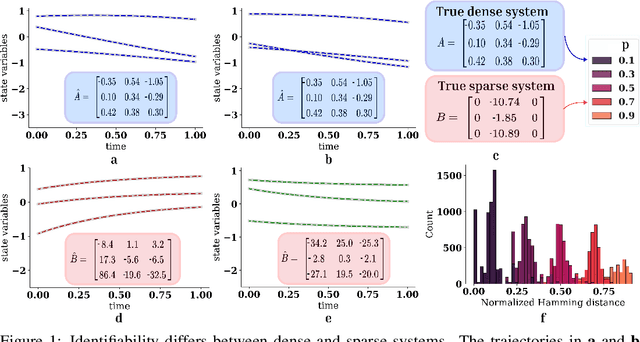
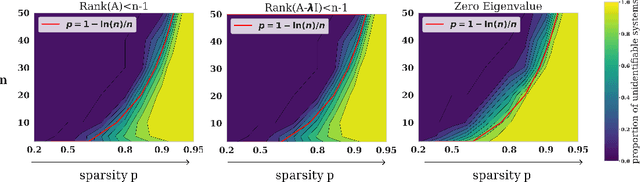
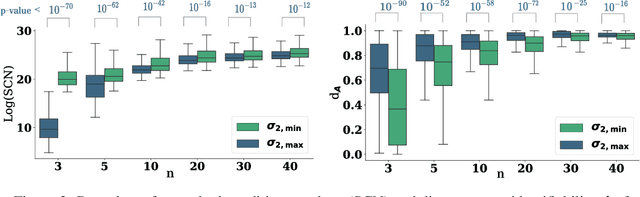
Dynamical systems modeling is a core pillar of scientific inquiry across natural and life sciences. Increasingly, dynamical system models are learned from data, rendering identifiability a paramount concept. For systems that are not identifiable from data, no guarantees can be given about their behavior under new conditions and inputs, or about possible control mechanisms to steer the system. It is known in the community that "linear ordinary differential equations (ODE) are almost surely identifiable from a single trajectory." However, this only holds for dense matrices. The sparse regime remains underexplored, despite its practical relevance with sparsity arising naturally in many biological, social, and physical systems. In this work, we address this gap by characterizing the identifiability of sparse linear ODEs. Contrary to the dense case, we show that sparse systems are unidentifiable with a positive probability in practically relevant sparsity regimes and provide lower bounds for this probability. We further study empirically how this theoretical unidentifiability manifests in state-of-the-art methods to estimate linear ODEs from data. Our results corroborate that sparse systems are also practically unidentifiable. Theoretical limitations are not resolved through inductive biases or optimization dynamics. Our findings call for rethinking what can be expected from data-driven dynamical system modeling and allows for quantitative assessments of how much to trust a learned linear ODE.
An Asymmetric Independence Model for Causal Discovery on Path Spaces
Mar 12, 2025We develop the theory linking 'E-separation' in directed mixed graphs (DMGs) with conditional independence relations among coordinate processes in stochastic differential equations (SDEs), where causal relationships are determined by "which variables enter the governing equation of which other variables". We prove a global Markov property for cyclic SDEs, which naturally extends to partially observed cyclic SDEs, because our asymmetric independence model is closed under marginalization. We then characterize the class of graphs that encode the same set of independence relations, yielding a result analogous to the seminal 'same skeleton and v-structures' result for directed acyclic graphs (DAGs). In the fully observed case, we show that each such equivalence class of graphs has a greatest element as a parsimonious representation and develop algorithms to identify this greatest element from data. We conjecture that a greatest element also exists under partial observations, which we verify computationally for graphs with up to four nodes.
Your Assumed DAG is Wrong and Here's How To Deal With It
Feb 24, 2025

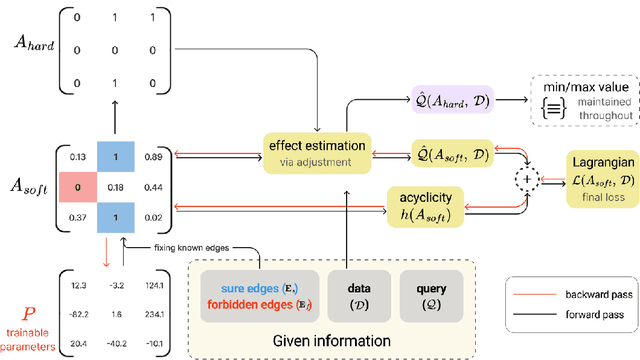

Assuming a directed acyclic graph (DAG) that represents prior knowledge of causal relationships between variables is a common starting point for cause-effect estimation. Existing literature typically invokes hypothetical domain expert knowledge or causal discovery algorithms to justify this assumption. In practice, neither may propose a single DAG with high confidence. Domain experts are hesitant to rule out dependencies with certainty or have ongoing disputes about relationships; causal discovery often relies on untestable assumptions itself or only provides an equivalence class of DAGs and is commonly sensitive to hyperparameter and threshold choices. We propose an efficient, gradient-based optimization method that provides bounds for causal queries over a collection of causal graphs -- compatible with imperfect prior knowledge -- that may still be too large for exhaustive enumeration. Our bounds achieve good coverage and sharpness for causal queries such as average treatment effects in linear and non-linear synthetic settings as well as on real-world data. Our approach aims at providing an easy-to-use and widely applicable rebuttal to the valid critique of `What if your assumed DAG is wrong?'.
Generative Intervention Models for Causal Perturbation Modeling
Nov 21, 2024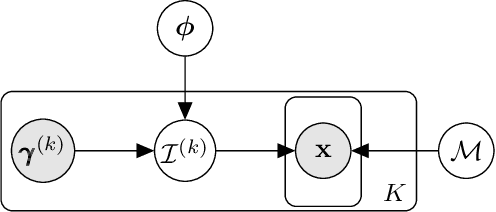
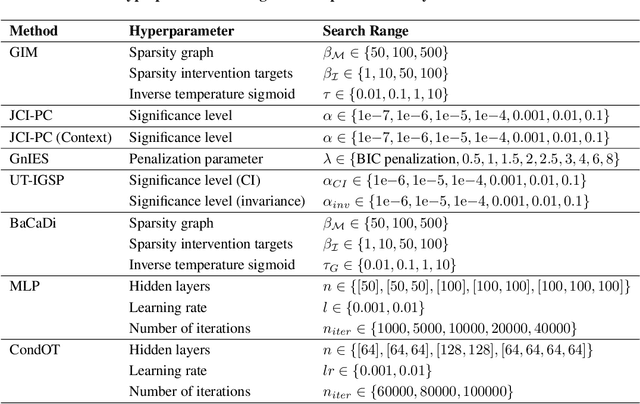

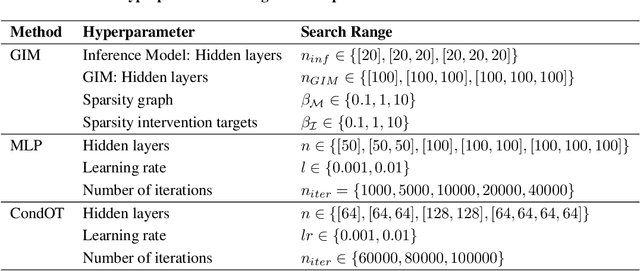
We consider the problem of predicting perturbation effects via causal models. In many applications, it is a priori unknown which mechanisms of a system are modified by an external perturbation, even though the features of the perturbation are available. For example, in genomics, some properties of a drug may be known, but not their causal effects on the regulatory pathways of cells. We propose a generative intervention model (GIM) that learns to map these perturbation features to distributions over atomic interventions in a jointly-estimated causal model. Contrary to prior approaches, this enables us to predict the distribution shifts of unseen perturbation features while gaining insights about their mechanistic effects in the underlying data-generating process. On synthetic data and scRNA-seq drug perturbation data, GIMs achieve robust out-of-distribution predictions on par with unstructured approaches, while effectively inferring the underlying perturbation mechanisms, often better than other causal inference methods.